
Imaginary Injuries
the drama around The Drama, To Catch a Predator, morality goons

When you comfort me, it doesn’t bring me comfort actually
Leslie Feist
What’s the worst thing you’ve ever done?
I didn’t realize this was such a popular parlor game, but here we are. In Lauren Groff’s Brawler, a group of childhood friends in their late forties/early fifties visit the deathbed of the final member of their quartet. In an effort to make her feel better, they confess their sins to one another.
One woman admits to a summer of unadulterated pleasure: the bad thing she did (which I will not reveal) was indulge in a prolonged moment of love, peace, and security. While many people would question the particulars of this situation, she bristles at the suggestion she shouldn’t have done it.
Many of the confessions go unjudged, likely due to the collective age of the group: once you get old enough, you simply stop investing so much energy into judging other people.
Unfortunately, we can’t discuss The Drama without spoilers. I posted a spoiler-free review here (IG/YouTube) but spoilers follow below this point.
Zendaya’s new movie The Drama, released Friday, April 3, has divided the internet. Spoilers started to trickle out a week before the film was released, but the conversation exploded this past weekend when the general public got their eyes on the film. (The movie did fairly well at the box office.)
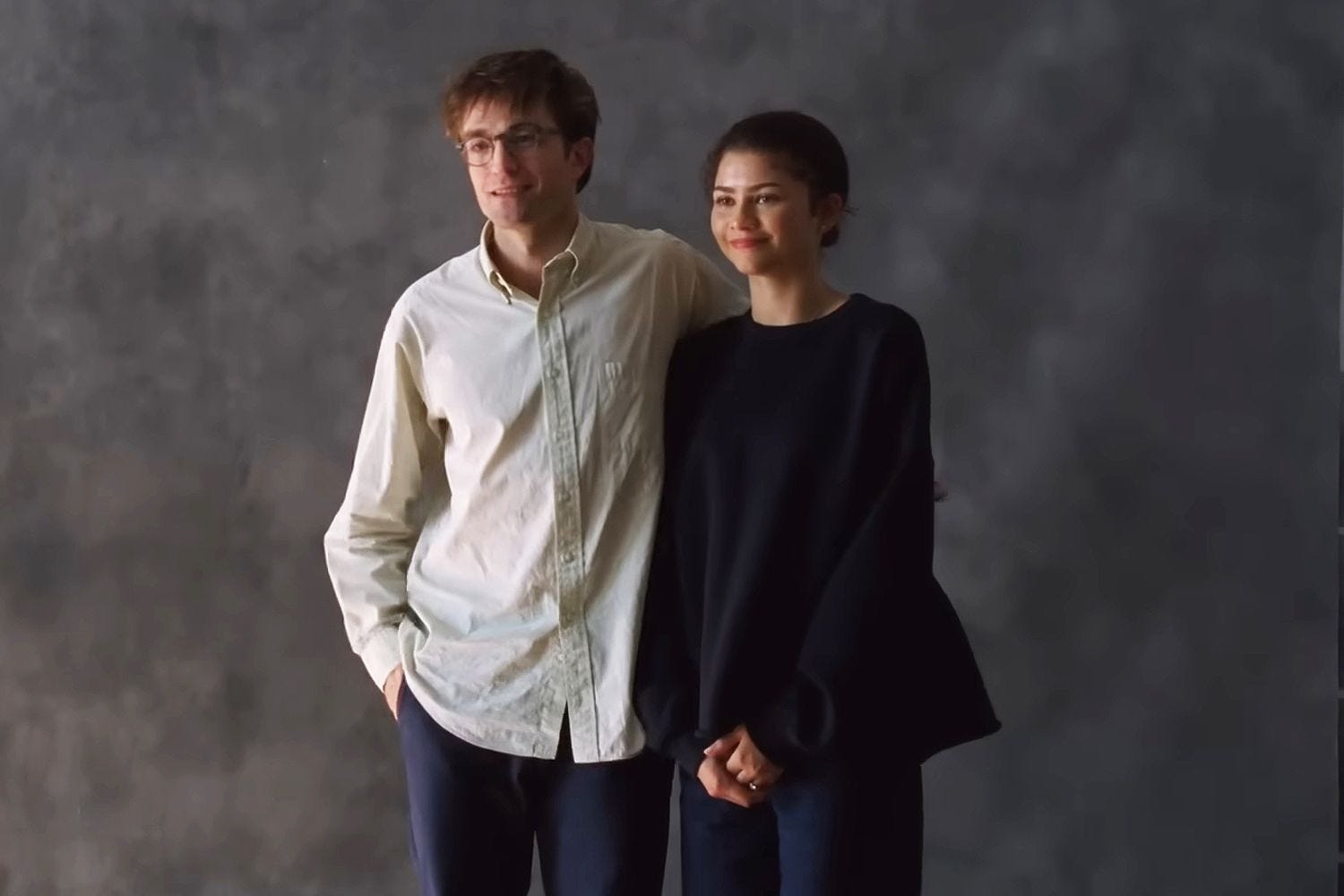
For the uninitiated, Zendaya and Robert Pattinson star as Emma and Charlie, a couple a week out from their wedding. When finalizing their menu, accompanied by Charlie’s friends Mike (Mamoudou Athie) and Rachel (Alana Haim, giving one of the worst, most wooden performances I’ve ever seen in my life), Rachel bullies everyone into revealing the worst thing they ever did.
The secrets are telling, giving insightful hints into the psyches of these characters. Mike and his former girlfriend were attacked by a dog, and he used her as a human shield. When things get difficult, he avoids conflict and lets his domineering wife terrorize everyone around him. Charlie cyberbullied a classmate so badly the kid moved, but he brushes it off, saying he was also a kid (they were 14/15). Charlie’s arc is the emotional arc of the movie, showing his propensity for spiraling, avoiding, weakness, and dodging responsibility— the classmate moved, but he’s not really sure. He avoids certainty, questions everything, and needs corroboration on all decisions (there’s a reason his friends are there when he has to make a decision regarding his own wedding menu).
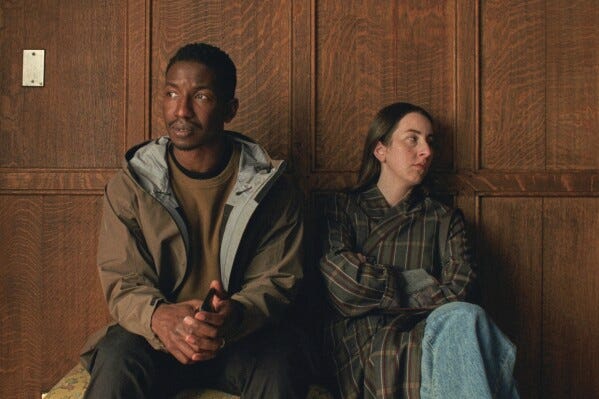
Rachel tells a story about locking a disabled child in an RV closet for 36 hours, and when confronted, says that the kid was fine. She is condescending and cruel, and the main antagonist of the film. She is never portrayed being kind, generous, empathetic, or graceful: at the very beginning of the movie, we meet the character telling Emma not to cry during her vows because she’ll look ugly.
Emma reveals that when she was 15, she planned a school shooting. She was 15 years old in Louisiana, bullied horrendously— we see scenes of her getting pushed into puddles, being told she smells, being shoved, ignored, and harassed. She didn’t go through with it because a shooting occurred at a mall close by, stealing her thunder and claiming the life of a classmate. When she sees the toll this takes on her bullies— at a school assembly, her main antagonist hugs her, breaking down in sobs— Emma devotes the rest of her teen years to advocating for gun reform. She wasn’t a psychopath after all: she craved community, and did a hard pivot from the online e-boys to real people at her school who thought she was smart and important.
Now, obviously, on its face, this is horrible. No one is excusing the horror of school violence and the severe impact each and every act of violence has caused on millions of American children and the psyche of the entire country. It’s unimaginable and devastating.
One viral review on here implied that no art should be made about acts of violence at schools because it’s too triggering. In 2021, Jenna Ortega and Maddie Ziegler starred in The Fallout, where they dug deep into the psychological effects of a school shooting on two survivors. In We Need To Talk About Kevin, the titular Kevin attacks a school with a bow and arrow, and we are meant to believe he’s a sociopath because he was unwanted by his mother. Mass is a tour de force about the fallout of a shooting, and Vox Lux details the rising pop stardom of a survivor of a school shooting.
I understand the impulse to bristle at the possibility of empathizing with the type of person who could commit an act like this, but I struggle to see that connection being made in The Drama. The movie specifically relies on the fact that she didn’t do it, and that the reactions of her partner and friends— horror, outrage, condemnation, shaming— are the actual point. The secret could have been anything. The secret is the vehicle for the actual story being told: is our capacity for love and forgiveness greater than our obsession with punishment? (This is clearly a subject the director, Kristoffer Borgli, is passionate about, as his previous film, Dream Scenario, deals with this as well.)
I’ve written about this twice before. On Substack notes, I said that we live in the Rachel generation: Haim’s character spends the rest of the movie berating Emma, calling her a horrible person and weaponizing her cousin being disabled due to a school shooting in order to act from a place of sanctimonious moral superiority. I’ve battled with this type of person for a decade now, as it’s the most common mode of commenter on the internet: everyone is evil, everyone deserves to be thrown away, everyone is out to get you. I also think the impulse to act from a place of moral righteousness is interesting, as it centers the experience of the self: the viral review of the movie I mentioned above dressed up their critique in flowery language, but ultimately amounted to “it made me feel bad and I didn’t like it and therefore shouldn’t exist”.
Antisocial Goods

It’s easy to be judgmental when you’re young. It’s something of a rite of passage. You watch adults make mistakes and say: that’ll never be me. I will never cheat, I will never fuck up, I will never get divorced.

I wonder if due to the proliferation of this type of person, we’re unable to clock it: I’m repelled by this personality type, so I avoid it, but I thought it was telling that in Vulture’s review, they describe Rachel as Emma’s “cheerful bud”, when she was never nice to Emma— not once. Every Black person watching the movie clocked how hateful Rachel was for the entirety of the movie’s runtime.
We’ve seen this time and time again. Lolita was under fire recently when a special anniversary edition was released. On the internet, commenters frequently struggle to understand the difference between depiction of a thing and endorsement of a thing. I battled a Bookstagramer when they said that Gillian Flynn was racist for… depicting literal skinheads in Florida using slurs in Dark Places. I said… do you think the author is racist for depicting a racist character? Should the author tell us telepathically then, if they’re not allowed to write about it? What does it say about media literacy that every villain apparently needs to have a sign flashing over their head, saying I DO NOT AGREE WITH THE ACTIONS OF THIS PERSON?
We have an issue with the centering of the self in criticism. In a discussion about Rejection, I spoke with someone who didn’t believe anyone would ever act like any of the characters. I asked them if they’d ever spent time online. I had a similar conversation when it came to Sheer: the character was a delusional villain, and I loved her. The same thing happened when discussing Universality, my favorite book of 2025: someone said they couldn’t imagine people that mean-spirited existed in real life, and I had to simply chuckle. If the extent of your media criticism is “this made me feel bad” or “I’ve never experienced this” then I fear we need to go back to the well.
The other argument floating around is that The Drama is unrealistic because shooters are very, very rarely Black women. I’m less interested in this argument because I don’t think it’s pertinent: the movie feints towards Emma being radicalized because of the aesthetics of the pipeline, donning black mascara and fingerless gloves, attempting to pose menacingly in the woods with a rifle. Doja Cat, a biracial pop star, was once under fire for being in “racial chat rooms showing feet”, frequently used slurs indicating that she was deep in 4chan pipelines and actively dated a Nazi. I have been on the internet for 25 years: there are people you would never expect being indoctrinated in pipelines you could never imagine. I’m not even going to go into the identity of it all, as I’ve been begging people to move past the Tumblr/Buzzfeed idpol for four years now: you cannot both claim moral authority because of your identity and then claim to be untouchable because of said identity.
Zendaya being a Black woman brings an interesting tension to the movie that does, sadly, go unexplored, but I think having Rachel commit a micro-aggression (she says her Black husband “grew up around guns”) indicates the director is playing with the optics of it all in a very specific way. (It’s interesting how everything the director does wrong is viewed as an act of deliberate sabotage or tantamount to a declaration of war, but everything he does right must be an accident or a stroke of luck. Commenter brain is rampant and poisonous.)
I think art and criticism will be questionable and boring if the only paintbrush people use is outrage. I don’t mean it in a conservative way: I simply mean that if the only emotion people are ever comfortable expressing is “this made me feel bad we must scream at the sky and demand accountability”, nothing interesting will ever get done. In my review for The Drama, I said the movie directly calls into question the American obsession with punishment. Can you be punished for something you’ve never done? People saying they would call the cops on their partners fifteen years later: what??
A few months ago, Sophie Gilbert wrote about To Catch a Predator, an aughts era show about would-be child predators being ensnared in police stings and confronted on camera. My initial reaction was to defend the show: these were the worst of the worst. They deserved what they got. The issue wasn’t the crime, it was the production around it: the show was canceled after a Texas Assistant District Attorney was caught in a sting and went into the bathroom (while cameras were rolling) to die by suicide. Americans were titillated by the spectacle of punishment, of seeing the criminal justice apparatus made into entertainment. This impulse has now spun into internet rings of vigilantes assaulting would-be predators on camera while live-streaming: a Black Mirror plot point made manifest.
I promise I’m not posturing. I briefly worked in the world of restorative justice, where people are truly allowed to earn second chances at redemption, forgiveness, and restitution. I have addiction in my family and I know where I come from (but am famously loath to trot out my identity in order to win arguments on the internet). I cannot live where I live, interact with the people I interact with, or be proud of my home while simultaneously believing everyone who’s ever made a mistake should be tried at The Hague, thrown in a dungeon, and never be seen again.

I think we’re in an interesting place when it comes to empathy: on TikTok, I said that America loves a victim (and a Trauma Plot) because it renders people legible: pity serves as a powerful social currency. The problem arises when trauma makes people mean, or hard, or difficult. On The Pitt, Trinity Santos alludes to coming from a foster care situation, alludes to abuse at the hands of a powerful, beloved man, and has self-harm scars. She’s hated by the fandom because she is callous and mean. (Another example of personal experience as thought terminating cliche: when I said she’s realistic because many doctors are famously rude/mean, I had hundreds of people tell me they shouldn’t be. Like, obviously?)
On Ladies of London, Kimi Murdoch got in hot water when she said some people bartered their trauma as a way to get people to like them, and that trauma at a party was boring (naturally, I love her.) She later reveals she wasn’t sure if she wanted to become a mother due to her own mother abandoning her at ten years old. Everything clicked for me: of course Kimi is mean, closed off, and wields humor as a shield, preventing anyone from connecting with her. She has her own shit going on and this is how it manifests, but people don’t feel bad for her because she’s not crying about it.
A few years ago, I made a video discussing the weird paradox of America’s obsession with apologies, which I do think is a cultural thing: in the Protestant tradition, apologizing is enough. We see this with celebrity apologies: they say sorry in a notes app screenshot and everyone moves on. In other traditions, we ask for atonement: you must work to make up for what you did, and simply asking for forgiveness does not guarantee you absolution (people learn this in AA/NA as well). Emma turns her life around after her internet-induced crime: she spends hours, days, weeks, months, years of her life advocating for gun reform. She shows a capacity for grace and understanding, advocating for keeping her wedding DJ after she and Charlie see her using on the street. She asks “do you want to be judged for what you did on the worst day of your life?”
For what it’s worth, I thought the movie was weirdly romantic. I thought the act/gesture of taking a leap and accepting your partner radically: truly understanding and accepting them, warts and all, the way we’re meant to, taught to, and supposed to, was a fascinating note to end on. Charlie is a coward and Emma is graceful, and these character quirks recur throughout the film to make the ending the only ending that would’ve made sense. It’s symbolic. It’s lovely.
On the internet, everyone is perfect. All of these furious commenters wield their moral superiority as cudgels, and pretend the act of righteously looking for flaws or mistakes in order to antagonize them or position themselves as better-than. I’m not anti-cancel culture, but I do think cancel culture died alongside woke: Louis CK wrote a book and went on tour. Chris Brown is always on tour. Sean Penn just won an Oscar. Jen Shah is sitting down with People magazine. The actual villains in our lives are out gallivanting. I don’t think a fictional movie about a hypothetical thought crime can be the ruler against which we measure our own morality.
We’ve lived through a decade of bad art and bad faith criticism because of people like Rachel needing to preen for the online masses. As a counterpoint: Rejection was longlisted for the National Book Award. Universality was longlisted for the Booker. Some people crave stories about the darker side of humanity, some people want to understand what makes fucked up people tick. I’m very glad you’re the best person in the world, but I must warn you: it’s limiting your scope and it’s making your art bad. True empathy comes from understanding darkness as well as light, and not zeroing in on morality plays in order to perform goodness for the masses. Some of you would do well to take a page from the Roman playwright Terence, who wrote: “I am human — nothing that is human is alien to me”.
Literally obsessed with everything you say
“I’m very glad you’re the best person in the world, but I must warn you: it’s limiting your scope and it’s making your art bad.”
You restore my faith in cultural/arts criticism!