
Traps and Puzzles
On loops and therapy

Early on in Nathan Hill's The Nix, a character has a conversation with a video game expert1 who tells him people can be placed into four separate buckets, depending on the role they play in one's life: enemies, obstacles, puzzles, and traps. At the end of the book, he spells out the difference between puzzles and traps:
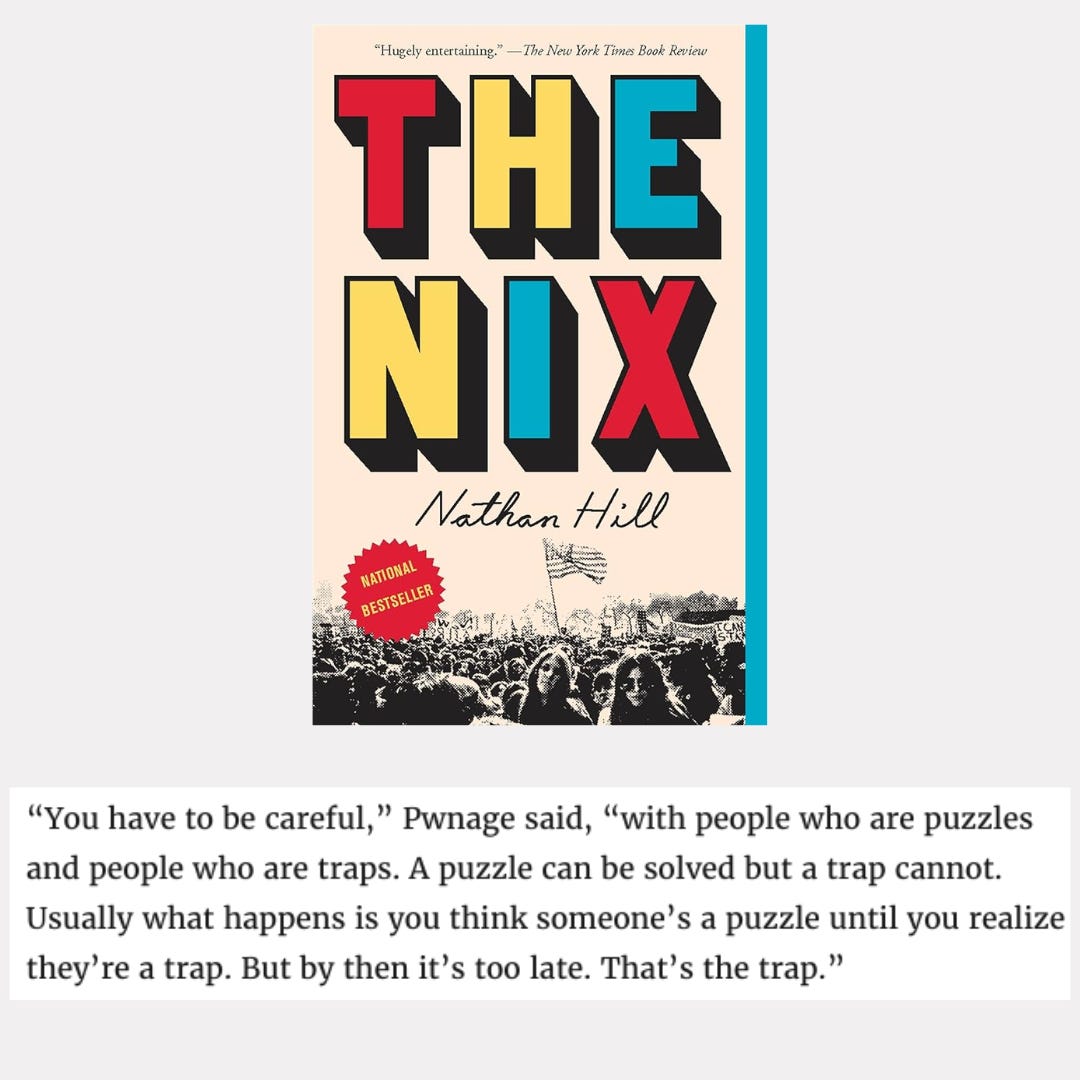
I read the book in 2016 and the quote has stuck with me ever since. While I personally don't categorize people this way, I’ve found it to be a helpful framework for thinking about mental health. In therapy, it’s understood that you go over situations and conversations over and over again in loops until you no longer make the mistakes you would have made previously. Things that can be fixed are puzzles. Things that cannot be healed are traps.
The quote recently came back to me when I saw a TikTok that featured Mitski's I Bet On Losing Dogs overlaid with the text: “If you bet on losing dogs long enough you become a losing dog yourself”. I've talked about my own avoidant personality before, but the quote struck me as a pitch perfect summation of dating emotionally unavailable people until you yourself become emotionally unavailable. Part of therapy is moving beyond the self awareness trap, or realizing that acknowledgement of your problems isn't the same thing as working on them.

Self awareness is a gift and a curse in Leslie Jamison's Splinters. I've talked about how much I love Jamison's writing before, but the deep dive into her psyche post-motherhood and post-divorce was beautifully written, poignant without being overwrought, relatable without being saccharine.
Splinters recounts both Jamison's grief about the end of her marriage and her excitement at dating again, imagining new futures with all of her suitors. Jamison writes about her flaws with the cool eye of someone who's been in therapy for years, dispassionately informing the reader of her “bad picker” and her tendency to jump into terrible relationships with terrible men as a way to fill the void alcohol once filled. Her courtship with her former husband is recounted in flashes, rolled out for readers like a disaster movie: we know the ending but we’re powerless to stop the incoming disaster.
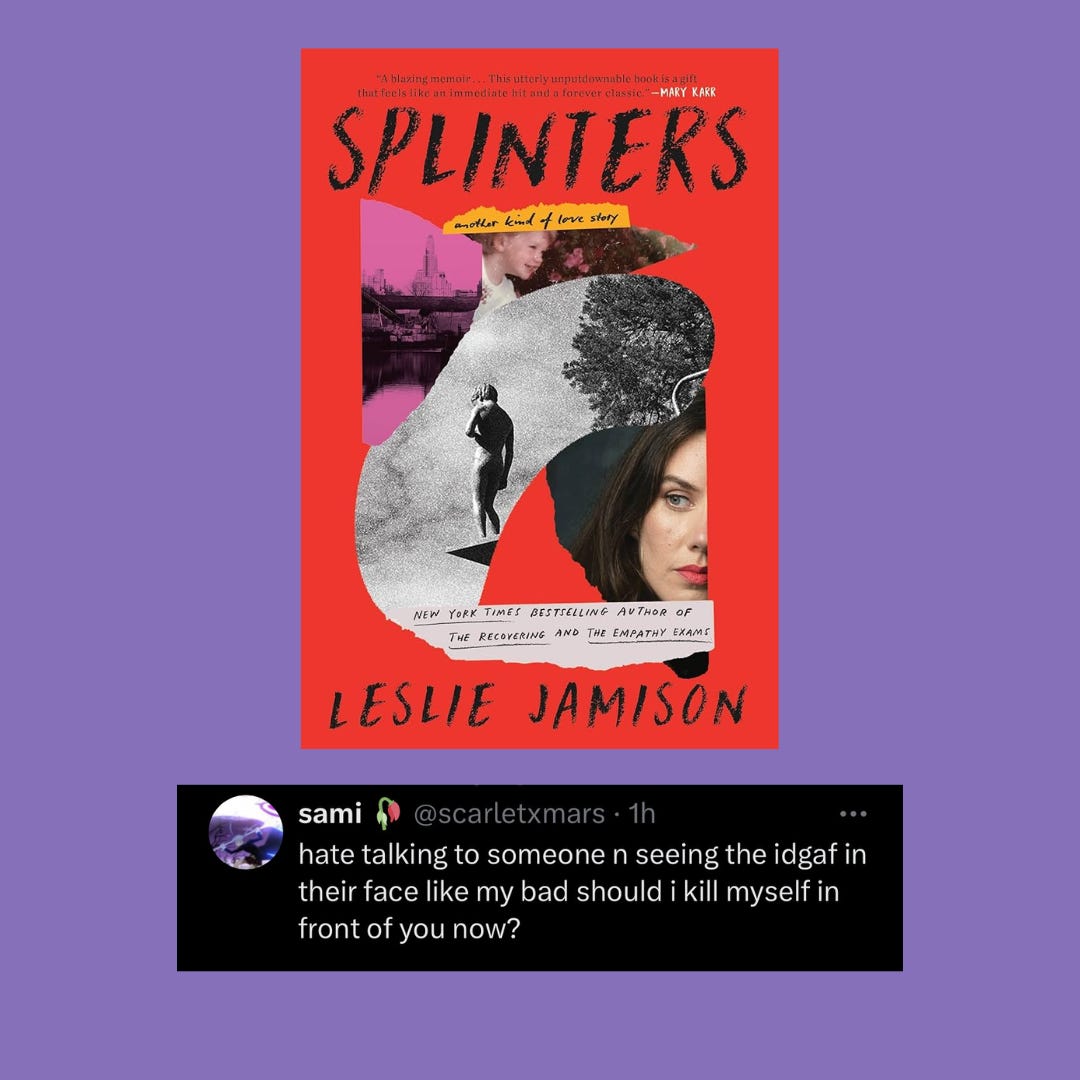
After her divorce, Jamison begins dating again. She dates boring men, interesting men, self-centered men, losers, winners, and financiers. For a few months she dates a charming man city-dwellers are very familiar with: successful, brilliant, handsome, and interested in a relationship. The only catch? He makes Jamison feel small. When she tells stories he’s uninterested in, he doesn’t react, and subtly makes her feel she has to perform in their relationship. After he unceremoniously dumps her, she falls into a passionate romance with… a traveling “homeless by choice” musician whose toxicity drips from the page.
At this point, you want to shake Jamison. Of course, the book is about the trap: she knows she’s stuck in this cycle of choosing the absolute worst possible man for herself, but I was praying/wishing/hoping/dreaming she would take the self-awareness and the lessons learned from her divorce and make a different decision. There’s the trap: just because you know better doesn’t mean you do better.

There is something to be said about picking the exact man who’s able to activate your insecurities. They’re unconscious loops for a reason. There’s something even sadder about getting older and continuing to be stuck. When The Golden Bachelor was airing, I made a TikTok about the runner-up, Leslie Fhima. Leslie was a 65-year-old fitness instructor who claimed to be the inspiration for a Prince song and was quickly branded the “hot girl” by the show. When it came time to reveal why she was single, Leslie informed the audience she had a habit of choosing men who only thought of her as sexy, but wouldn’t marry/settle down with her. She was drawn to the show’s lead because he was kind, and she felt the situation would end differently.
Spoiler: it did not. Gerry chose the docile Theresa Nist, and Leslie became the girl who almost got the guy once more. Leslie is currently being attacked by the (famously toxic) Bachelor fandom for not being over the situation after she brought up her jilting on a recent episode of The Bachelor. I’ll defend Leslie on one point: I also wouldn't be over a very public rejection by a man whose entire persona is being kind and sweet. The thing that confused me then and confuses me now is the fact Leslie is in her sixties and still deeply attached to the narrative that she’s not good enough to be a wife, despite two previous marriages.
I’ve talked about the millennial obsession with therapy before, but it is something I hold onto. I believe in putting in the work and Getting Better, and the thought of being in my sixties and still choosing partners who activate my core wounds chills me to my core. I wish Leslie the best.
Reality television is fascinating for many reasons, one of them being that you can see people change, evolve, and grow in real time. Unfortunately, many people on these shows simply do not grow up, and watching them navigate the detritus of their personal lives continues to be a major draw for viewers.

Depending on who you ask, Kristen Doute is either a source of great consternation or great entertainment. Haunting our screens from 2013-2020, Doute (pronounced Dough-tee) started her career in reality television on Vanderpump Rules, being introduced as a chaotic waitress in a relationship with Tom Sandoval (yes, that Sandoval). I’ve called Doute Our Lady of Suffering and the Cassandra of VPR: her penchant for predicting disastrous situations was unparalleled, but the ability never protected her.
On the second season of the show, it became clear that Kristen and Tom Sandoval were constantly cheating on one another. Sandoval was openly flirting with Ariana Madix, bartender and future Scandoval victim, and the brazen flaunting of their affair sent Kristen over the edge: she spent most of season two weeping, smoking, smudging her mascara, and screaming at Sandoval. At one point, she sees Sandoval speaking to Ariana and begins crying on the job. Sobbing, she goes up to Lisa Vanderpump and says simply: “Lisa, I’m devastated.” Without missing a beat, Lisa responds, “Kristen, when aren’t you devastated?”
I’ve said before that Vanderpump Rules is about misogyny, alcoholism, and infidelity. Despite knowing her boyfriend was having an affair, the rest of the cast decided Kristen was the villain for “not being chill enough” and blaming her for handling the entire situation extremely poorly. Kristen’s reputation was sullied forever when it was revealed she had cheated on Sandoval with her best friend’s ex boyfriend, the supervillain Jax Taylor.
Kristen went on to date demon twink James Kennedy (who spit at her and slut shamed her constantly after their breakup) and Carter, an under-employed photographer whose lifestyle she funded. When confronted by her friends about paying Carter’s bills, Kristen cried and told the audience she was in her late thirties and simply didn’t want to be alone. It was a heartbreaking display of pathos. I don’t believe Kristen is perfect: she was fired from the show in 2020 for calling the police on a Black cast member, and has since apologized. I personally forgave her, but as always with these things, the community isn’t a monolith, and it’s up to individuals to decide whether they forgive people or not.
Kristen is back on our television screens in The Valley, a Vanderpump Rules spin-off featuring Jax Taylor and other forty-year old friends of the Pump Rules cast who are all married with children. Alarm bells quickly rang for me when Kristen revealed she was in a long distance relationship with a man who lived in Colorado and had no plans to move to Los Angeles. Those alarm bells blared when she revealed her sole story-line on the show was trying to conceive a baby with the man she had only been dating for a few months because “all of her friends had children”.
Once again, the trap revealed itself. I had hoped Kristen would use the four years off of reality television to heal, especially since she constantly talked about going to therapy and beginning to take medication. Unfortunately, it seems her happy ending was a misdirect: she’s in another questionable relationship and acting up on television, except this time, she’s forty. The desire to be loved (a desire that drives every decision JLo makes) can often manifest itself as an inability to be alone. You think you can solve the problem until you find yourself in five terrible relationships in ten years.
I sought out examples of men stuck in loops, but it might be internalized misandry that I didn’t even consider rooting for men on reality television. Many of the narratives I’m drawn to are about women overcoming the terrible circumstances (and terrible men) in their lives.
But for inclusion’s sake, Jax Taylor and Tom Sandoval operate in similar ways: they use women as escape hatches. Jax cheats to detonate relationships, and believes being a husband and father absolves him of all wrongdoing. Sandoval begins protracted affairs in order to secure a soft landing when he leaves one relationship for another, and immediately begins dating his affair partner before inevitably cheating on them as well. The belief that trading in one relationship for another can fix you is likely a trap of a different sort.

Of course, it’s very possible to argue that the obsession with therapy can be seen as its own trap. A recent article in GQ points to the recent inclusion of therapy-speak in music as proof of the corporatization of mental health. Ariana Grande, Noah Kahan, Kacey Musgraves, and Sza all discuss The Work in their music, making their healing part of their oeuvre.
I remember being on Tumblr and fans collectively losing their minds when their favorite artists got therapy, claiming their art would change. Marina’s Love + Fear was very different from Froot. Florence’s High as Hope was beautiful, but a shift from the pure sonic wall of HBHBHB. And I can’t even talk about Lorde’s Solar Power without causing a stan war. Did therapy change the music? Sure. But how much of this can be attributed to the natural growth artists go through as part of their careers?
In therapy terms, constantly seeking to “fix” oneself can be seen as a manifestation of several negative core beliefs: I’m worthless, I’ll never be good enough, I need to be perfect before someone will love me. It’s interesting that the normalization of therapy occurred at the same time modern culture began telling us everything in our lives needed to be operationalized (optimized), rationalized, healed. Millennials love solutions, and more than anything, they love being able to outsource whatever is currently plaguing them2. Do I love therapy or do I love the idea that every problem in my life can be overcome? After all, you don’t realize you’re in a trap until you’re stuck. That’s the trap.
Further Reading:
When Did Everyone Get So Dysregulated?
TTB Book Club members: IRL meeting next week! Don’t forget to RSVP.
A video game expert named Pwnage. Remember L33t speak?! Make it 2008 again via science or magic!
I’ve talked about millennials outsourcing post-breakup moves, divorces, weddings, making friends, moving, apartment hunting, car buying, etc. You can name a start-up meant to “help us” fix each of these things.