
How Mean is Too Mean?
unstoppable force meets immovable object

“... Because Hannah doesn’t see herself as a person with any power, she doesn’t realize that she’s capable of hurting anybody else’s feelings. The world is happening to her.”
— Lena Dunham on Amy Poehler’s Good Hang Podcast
Can great art be made about a video game? In Dad Don’t Read This, we’re transported into the bedroom of a teenage girl obsessed with The Sims. I was a bit obsessed with the play before even seeing it— the Plumbob heavy marketing appealed to a deeply primal part of me, a side of myself I hadn’t accessed in years.
From 2004 to 2016, I was obsessed with The Sims 2. I participated in multiple Legacy challenges, where you play one family for ten generations, accruing points for every achievement: reaching the top of a career, having children, getting married, dying in creative and unexpected ways (the ghosts were different colors depending on how they died). I then embarked on a Prosperity challenge, playing a group of families, round robin style, for five generations. I played one neighborhood— by the third generation every family had intermarried and intermingled— for a decade. I have records and notebooks and spreadsheets detailing lineages and personalities, their wants and fears tallied up neatly.
For the uninitiated, The Sims is a life simulation game. You create little people and control them, either acquiescing to their wants, dreams, and hopes, or terrorizing them by making their worst fears come true. In The Sims 2, they have Aspirations— Family Sims dream of having ten children, Knowledge Sims dream of being abducted by aliens, Fortune Sims dream of earning $100K, Popularity Sims dream of having 50 friends, and so on.
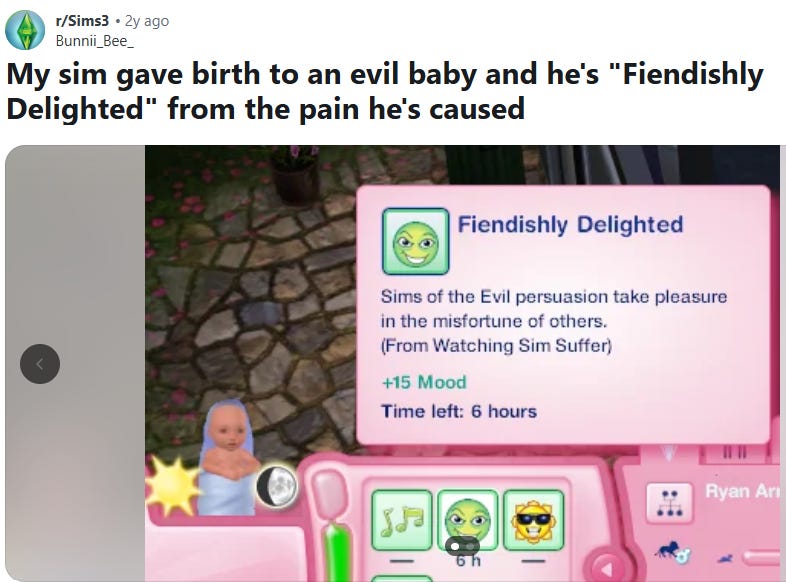
Dad Don’t Read This specifically ties the love for this particular game with a love of control. The horror of being a teenager is expressly realized in the lack of control: most of the play is about a girl who cannot leave her room for mysterious reasons, and the friends that come to visit her. The Sims is the only thing that makes her happy, giving her control in a place where she has none— her parents are fighting nonstop, her friends can’t hide their worry, her body is changing, school is tough. She’s a difficult person facing difficulties that in turn, make her more difficult.
The Sims makes manifest what many of us, ostensibly, want out of life: the life paths are delineated quite clearly. Once you’ve played the game for years, you can suss out what Sims want on a macro level, and choose to indulge them or not. Becoming mayor, or adopting a baby, or getting a puppy, or being friends with your sibling: all of the things they could want are preprogrammed and unsurprising, but there is a quiet pleasure in making them happy, seeing their Plumbobs shine brilliantly when they’re in good moods. Occasionally, the game will throw you a curveball: a happily married Sim will suddenly desire to flirt with someone else, a Fortune Sim will randomly wish to quit their job or begin a completely random career track. These keep the game interesting, but at the end of the day, you’re still pointing and clicking, ushering them along until they get old and die.
(In the first Sims game, The Sims, there was no aging. You played the family forever and ever, the children trapped in a sort of purgatory of permanent childhood where they’d go to school every day for all eternity, as there were also no weekends. The Sims 2 introduced aging, wants, recessive and dominant genetics, and thousands of other features that make it the superior game in the franchise.)
In the age of the Influencer, control is a topic that comes up again and again. Last month, nursing influencer Jen Hamilton posted a video of her crying and immediately deleted it. She had been transparent with her 7 million (million, as in her follower count is higher than the population of states like Indiana, Missouri, Wisconsin, etc.) followers about troubles in her marriage previously, so alarm bells went off. The next day, she confirmed a split from her husband, and specifically stated that she could not ask for privacy— as she had monetized her life to such a degree that she understood people would have questions— but asked for kindness instead.
On TikTok, I explained one of my core beliefs: once you let the devil in, you cannot tell him where to sit. Jen Hamilton herself understood that she had made her marriage part of her content, and thus people who consumed her content would ask about her marriage. I was meaner in my video than usual, but I very clearly said that once you choose to monetize your personal life, it will be very difficult to unspill the milk, as they say. This in turn led to hundreds of white women (I would never say this on there, but here I can be honest— similar to the people furious with me about Lindy West, 99% of them were Gen X white women) excoriating me in my comments. People said that I didn’t understand the concept of consent because of a three minute long video about fame and the Faustian bargain.
On Reddit, thousands of people began clamoring for details on the demise of her marriage, but I genuinely didn’t care about the details: in my mind, Jen Hamilton and I are on the same page. She knows you can’t put the genie back in the bottle. Unfortunately, her stans wielded kindness (the marriage of the right to comfort and fear of open conflict, core tenets of white supremacy culture) as a cudgel to silence any detractors.
To date, Jen Hamilton has posted seven additional videos about her divorce.
As social media changed the nature of fame, kindness became a rallying cry to protect against dissenting opinions. It felt like whiplash— growing up in the nineties and early aughts, everyone was mean. Millennials grew up in a mean culture. The tabloids were brutal— remember how they talked about Britney Spears? Jessica Simpson? Eddie Murphy? Hugh Grant? Whitney Houston? Brandi? The Gilmore Girls were mean, the Friends were mean, the characters on Seinfeld were famously mean, the friends on How I Met Your Mother and the coworkers on The Office all bore this out— we were a culture of razzing and jabs, of shade and not so gentle ribbing.
Not to be Wicked on main, but I think of: are people born wicked? Or do they have wickedness thrust upon them? I’ve written about coming from hard stock. My people are pragmatic, hard, cold, stern. I grew up as an underweight gay child in The Bronx. Where exactly does the expectation of niceness come from? Thinking even one layer deeper, I talked about The Velvet Rage and gay male socialization, how internal shame manifests and projects itself outwardly into the viperous cattiness many gay men are known for today. I personally have never been socially rewarded for being nice, kind, warm, or sweet. One layer deeper than that, many commenters pointed out that straight men aren’t exactly nice either— many men in general are not rewarded for being nice, kind, warm, or sweet. This is quite literally just the patriarchy.
Of course, all of this could be a cop out. Many pointed out that we always have a choice— as someone who studied sociology, I can’t just throw my hands up in the air and point at Culture and say I have no choice in the matter. There are thousands of shades between determinism and free will.
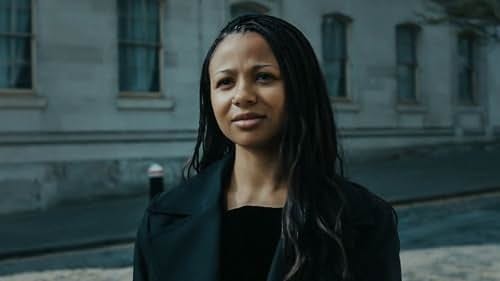
For a culture obsessed with trauma, people are often reticent to admit that there’s not always a light at the end of the tunnel. Millennial optimization culture and our obsession with therapy made us believe that on the other side of suffering, there awaits serenity, peace, and wellbeing. No one is keen to discuss how sometimes, trauma can make you mean, unkind, or unempathetic. On Industry, Harper Stern gives a furious speech attacking this very idea, saying:
“My trauma made me stronger? No, no! My trauma traumatized me. And it made me fucking weak.”
I wonder if my lack of empathy (Capricorn stellium) is less a party trick and more an effect of the culture I was raised in. A few years ago, I asked where the empathy was for the people who were made tough by their circumstances. People can understand many situations, but somehow short circuit when they encounter someone who doesn’t lead with kindness, likely because they’ve never been taught to.
Of course, there is resistance. So much of my identity is tied up in resisting victimhood, that seductive siren of the Millennial generation. I’ve watched so many people online surrender themselves completely to the call, giving up their agency and personhood in pursuit of the noble suffering of eternal victimhood. I can’t have it both ways: I can’t spend all my time calling out the obsession with victimhood while also defending my right to be mean to people because it’s just how I was raised. It’s another example of my agency being excised completely.
There are glimmers of hope. In Thinking, Fast and Slow, psychologist Daniel Kahneman discusses two different types of thinking, which he coined System 1 and System 2. System 1 is the knee-jerk response, the instantaneous unburdened thought. System 2 is purposeful, locked in, and deliberate. I’ve found that when I drill down on Substack, I find wellsprings of compassion— for the deeply lonely, for people talking to machines, for very young people falling down the incel pipeline. Perhaps focusing so much on System 1 thinking on TikTok (where the quick take is rewarded) is preventing me from accessing the compassion hidden just one layer underneath.
They say that being in your mid-thirties is about accepting responsibility for the way you grew up, and not using it as an excuse to define your life story anymore. The story I’ve been telling myself— that I’m from the Bronx, that everyone in my family is mean, that kindness won’t get me anywhere since I’ve never gotten points for it— could be just a story. We can get addicted to our own mythologies, married to stories that keep us stuck. The real work is in release. Who am I when I don’t say the first thing that comes to mind? Who am I when I consider the human? Have I been defeated by the kindness warriors? Am I just getting old?
I guess we’ll find out together.
Links:
Dad Don’t Read This is on until Saturday, 7/18. I loved it (video review). The Times and Vulture loved it too, if reviews sway you, but it’s a story of girlhood, teenagerhood, being powerless, struggling, and being furious. It’s incredible.
I realize I shared an article a month that was much more pro-plastic surgery, but all viewpoints are fascinating to me. There’s a major ideological divide happening here and the language used to argue for/against is really, really interesting.
‘love island’ and the mirror of red pill ideology in modern dating
Hollywood Thrives on ‘Rabid’ Fans. For Publicists, They’re a Nightmare (I also posted about Club Chalamet being attacked by a Parisian Non-Binary teenager/young adult)
How Lizzo Became One of Pop Culture’s Great Flops (tough title but a good read about the attention economy and the changing nature of music streaming!)
Tomi Adeyemi Is Acting in Bad Faith Over the Film Adaptation of “Children of Blood and Bone”
They Tried to Catch a Predator. They Trapped Themselves Instead.
The Secret to the Biting Sexual Dynamics of ‘The Invite’: Esther Perel
I loved The Invite. Video review here.
The opening quote is one I've been thinking about a lot, and is in fact one of the animating themes of my life - because I grew up alienated and outcast from the majority of my peers, I spent far too long believing that my words had no power, and I was incapable of hurting anyone's feelings because no one actually cared what I thought. In college, and then again repeatedly in my twenties, I have been forced to reckon with my own Liz Lemon Pass (specifically the episode "Reunion," where Liz finds out that her cruel jabs at her classmates were not in fact unheard and under her breath but were the source of great trauma for many of them). I also wrote an essay about free will, and about how ultimately infantilizing it is to insist that no bad thing that has ever happened to me has ever been my fault in any way. Ultimately, I find all of this incredibly hopeful. While so much happens against our will, we do have so much choice in how we react to it, and what we take with us, and what we cast aside in favor of better fuel. Also, I'm currently in recovery from my most recent Sims hyperfixation...I should have known we were alike in this way.
I have ADHD. The gap between the impulsive thought and the considered one is something I manage every day. Your TikTok/Substack split maps onto that perfectly: the platform you think on changes what you're capable of thinking.